
If your oncologist has suggested a PET-CT scan, you’re probably wondering why, especially if you’ve already had a mammogram, ultrasound, or MRI. It’s a fair question. Here’s the simple answer: a PET-CT tells doctors things that other scans can’t.
Most imaging tests show what a tumour looks like, its size, shape, and location. A PET-CT goes a step further and shows how active the cancer cells are. It does this by tracking how cancer cells use sugar (glucose), since cancer cells tend to be greedy, growing and multiplying faster than normal cells, they light up on the scan. Combine that with a CT scan happening at the same time, and doctors get both the picture and the behaviour of the disease in one sitting.
Here’s a Closer Look at When and Why this Matters.
1. Getting an Accurate Picture of How Far the Cancer has Spread
Before deciding on a treatment plan, doctors need to know exactly where the cancer stands, has it stayed in the breast, moved to nearby lymph nodes, or travelled further to the lungs, liver, or bones? This is called staging, and it’s one of the most important steps in cancer care. Get it right, and treatment decisions become far more precise.
2. Catching a Recurrence Early
Cancer coming back after treatment is every patient’s biggest fear, and it’s understandable. If there’s any suspicion that breast cancer has returned after surgery, chemotherapy, or radiation, a PET-CT can often pick this up earlier than a standard scan, sometimes before any visible changes would show up otherwise. Early detection here can make a real difference in how the situation is managed.
3. Checking if Treatment is Actually Working
Chemotherapy, targeted therapy, immunotherapy, these treatments take a toll, and naturally, patients want to know if they’re working. A PET-CT can show whether the tumour’s activity is slowing down or shrinking, giving oncologists a clearer sense of whether to continue the current plan or switch course. Instead of waiting months to find out, doctors can adjust treatment sooner if it’s needed.
4. Finding What other Scans Might Miss
Sometimes cancer spreads in ways that don’t show up clearly on a CT, MRI, or ultrasound alone, particularly in patients with more advanced disease or symptoms that don’t quite add up. PET-CT is especially good at spotting these hidden or small metastatic spots, which can change the entire treatment approach.
5. Helping the Whole Medical Team Plan Together
Breast cancer treatment usually isn’t a one-doctor decision. Surgeons, oncologists, and radiation specialists often need to sit down together and map out the best path forward. A comprehensive PET-CT provides this team with the best possible starting point, allowing the treatment plan to be based on solid information instead of guesswork.
So, When is a PET-CT Actually Recommended?
To be clear, not every breast cancer patient needs one. It’s typically advised in specific situations, such as:
- Locally advanced breast cancer
- Suspected spread to other organs
- Suspected recurrence after treatment
- Unexplained symptoms or rising tumour markers
- Checking how well treatment is working, during or after therapy
For most early-stage cases, it isn’t routinely needed. Your oncologist will look at your specific situation, the stage, symptoms, and treatment goals, before deciding if a PET-CT adds real value to your care.
PET-CT at KD Cancer Centre
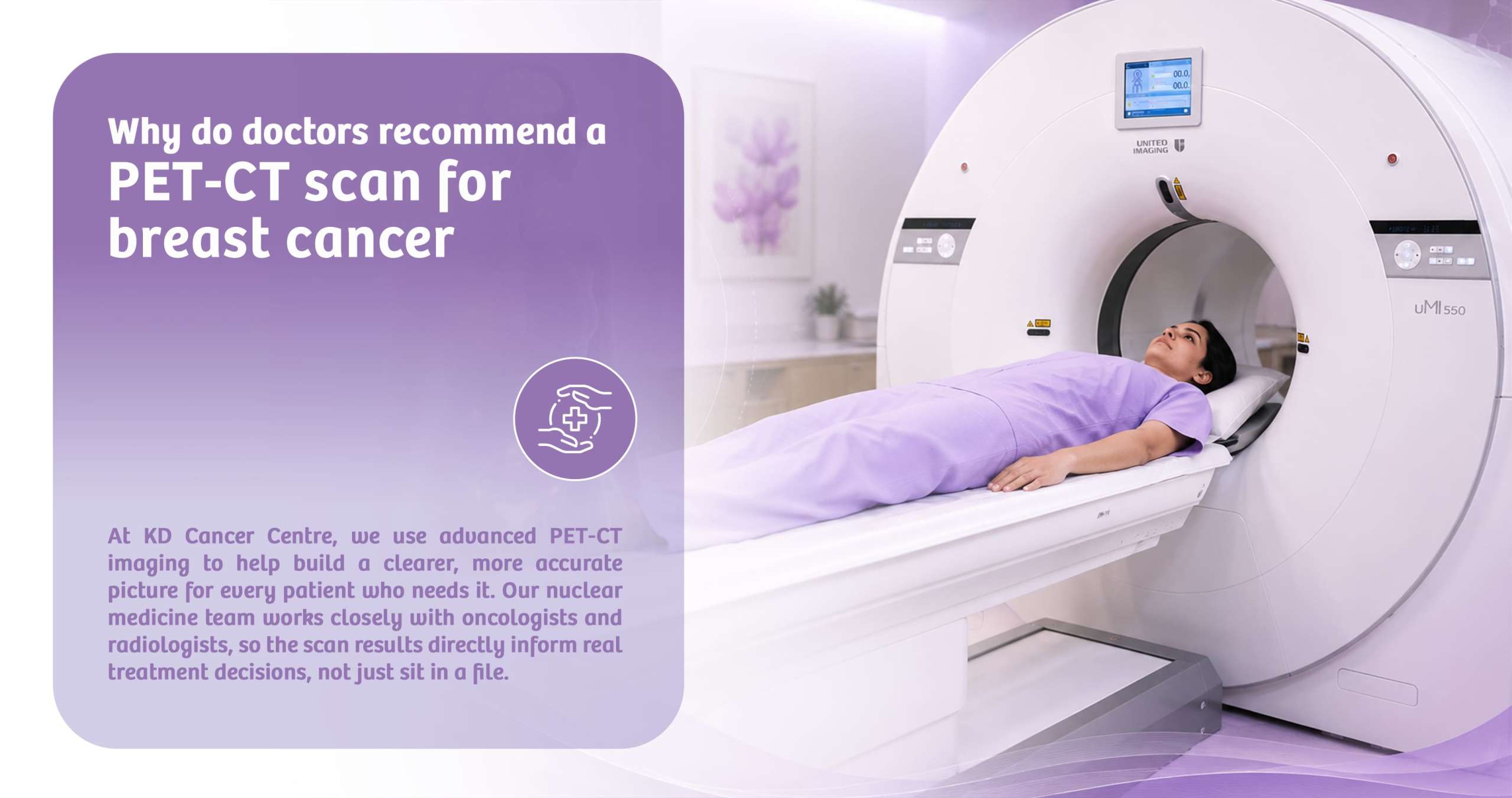
At KD Cancer Centre, we use advanced PET-CT imaging to help build a clearer, more accurate picture for every patient who needs it. Our nuclear medicine team works closely with oncologists and radiologists, so the scan results directly inform real treatment decisions, not just sit in a file.
At the end of the day, breast cancer care comes down to three things: catching it early, staging it accurately, and treating it without delay. A PET-CT scan, used at the right time, plays a real part in getting all three right.