


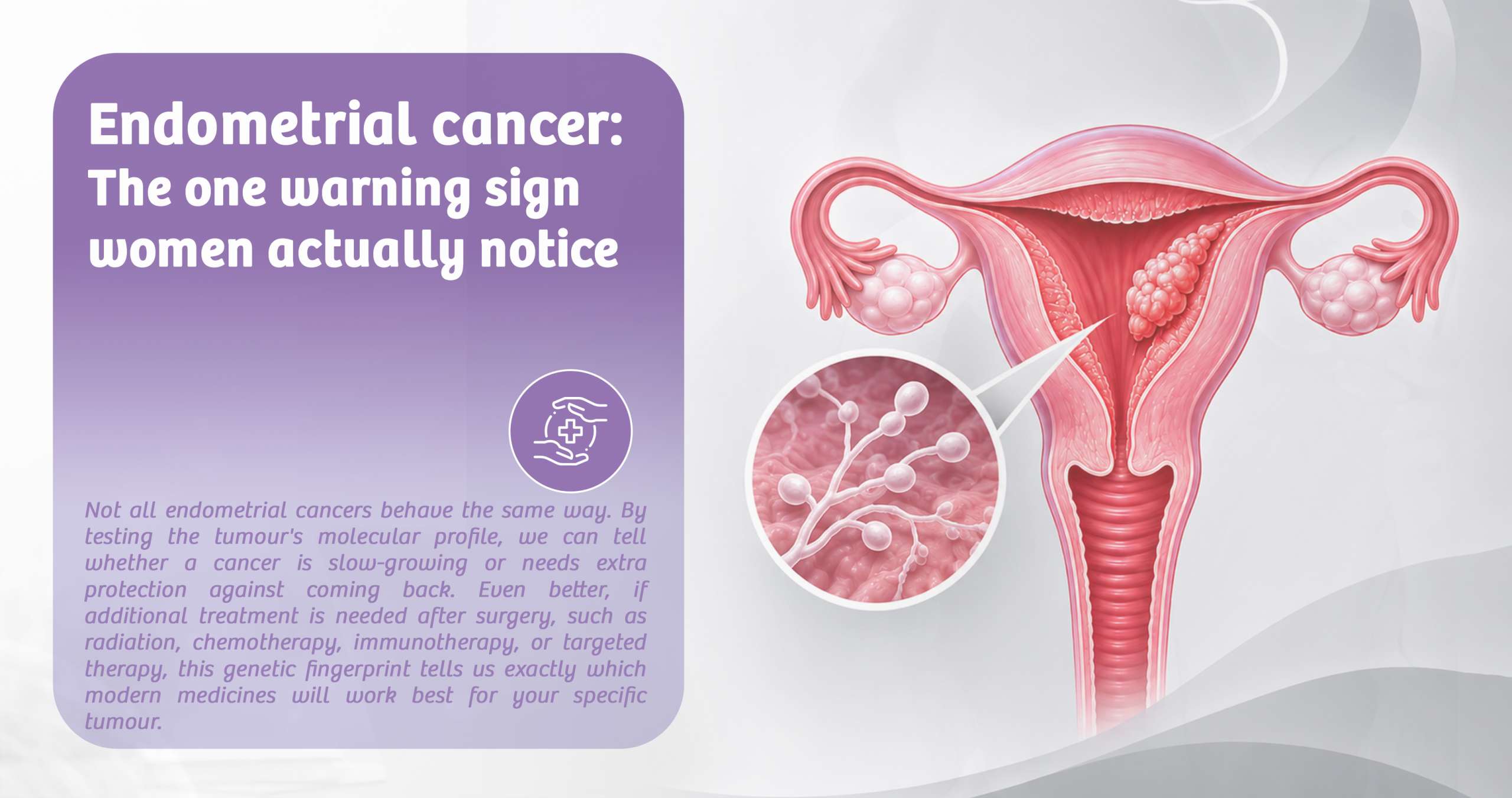

Here is the unusual thing about endometrial cancer (cancer of the uterus lining): Unlike most cancers that grow silently until they are advanced, this one is actually not subtle. In most cases, it announces itself early through bleeding that shouldn’t be happening.
Yet, women put off seeing a doctor about it all the time. Not because they don’t notice it, but because it is so easy to explain away. “It’s just perimenopause.” “I’m stressed.” “My cycles have just been weird lately.”
At KD Cancer Centre, Ahmedabad, we see this pattern far too often. A patient will mention, almost in passing, that unusual bleeding started months ago. That gap between noticing a symptom and calling a doctor is where the real danger lies. This guide helps close that gap.
What is actually happening inside the body?
The endometrium is the inner lining of your uterus; it gets thicker and prepares for a possible pregnancy. If pregnancy does not occur, this lining sheds during menstruation. Endometrial cancer develops when cells in this lining begin to grow and multiply uncontrollably, disrupting the body’s normal cellular regulation.
While ovarian and cervical cancers tend to get more public attention, endometrial cancer is actually the most common cancer of the female reproductive system in many parts of the world. It most often appears after menopause; though younger women can get it too.
The symptom that matters most
If you take only one thing away from this article, let it be this: bleeding after menopause is never normal. Not light spotting, not a pink tint, and not even if it happens just once. About 90% of endometrial cancers are caught early simply because someone noticed postmenopausal bleeding and got it checked.
Before menopause, the signs can be trickier to spot because periods naturally fluctuate. If you notice:
- Periods that suddenly become much heavier or last longer than what is normal for you.
- Bleeding or spotting between your regular periods.
- A watery or blood-tinged vaginal discharge.
- Persistent pelvic pain or a feeling of pressure in your lower belly.
A quick note on pain: Pelvic pain usually shows up much later. Bleeding is the early alarm bell; do not wait until you feel pain to get checked.
Who is more likely to get it?
Most cases come down to a hormone imbalance, specifically, having too much oestrogen circulating in the body over time without enough progesterone to balance it out. Several factors can tip that scale:
- Body weight: Fat tissue naturally produces extra oestrogen, meaning carrying excess weight increases lifetime oestrogen exposure.
- Reproductive history: Starting your periods very early, going through menopause late, having Polycystic Ovary Syndrome (PCOS), or never having been pregnant all mean your uterus has been exposed to oestrogen for more years.
- Certain medications: Taking oestrogen-only hormone replacement therapy (without progesterone) if you still have your uterus, or taking Tamoxifen (a medication used to treat breast cancer), can slightly raise your risk.
- Family history (Lynch Syndrome): Lynch syndrome is an inherited genetic condition that significantly increases the risk of both colon and endometrial cancers. If this runs in your family, tell your doctor so you can discuss closer monitoring or preventive steps.
- Other health conditions: Diabetes and high blood pressure are also frequently seen alongside this diagnosis, often tied to shared risk factors like body weight.
Getting diagnosed is straightforward
Because the early warning signs prompt women to seek help quickly, diagnosing endometrial cancer is usually a fast, uncomplicated process:
- Ultrasound: Doctors usually start with a simple pelvic ultrasound to measure the thickness of your uterine lining. After menopause, the uterine lining is normally thin. Any unexpected thickening may require further evaluation to identify the underlying cause.
- Endometrial biopsy: When a patient needs to go for a biopsy, a doctor takes a small portion of tissue from the uterine lining. This is a quick clinic procedure and does not require a hospital stay. If further evaluation is needed, your doctor may recommend a minor procedure called hysteroscopy with dilatation and curettage (D&C) to examine the uterine lining and collect a tissue sample for testing. It helps the doctor to look directly inside the uterus and take a thorough sample.
- Scans: Once confirmed, an MRI or CT scan helps doctors see if the cancer is confined to the uterus or if it has spread, which guides the exact treatment plan.
Modern treatment: Smarter surgery & personalised care
For most women, surgery is the first and most important step. Because this cancer is typically caught early, many patients are completely cured by surgery alone and need no further treatment.
At KD Cancer Centre, whenever possible, we perform this surgery using minimally invasive robotic or laparoscopic techniques; meaning tiny incisions, less pain, a shorter hospital stay, and a much faster return to normal life.
Today, surgical and medical care has become much more precise thanks to two major advancements:
1. Sentinel lymph node biopsy (Gentler, Smarter staging)
In the past, surgeons often had to remove dozens of lymph nodes from the pelvis (a full lymphadenectomy) just to check if microscopic cancer cells had spread. Removing that many nodes could sometimes cause long-term leg swelling (lymphedema).
Today, we use sentinel lymph node biopsy (SLNB). Think of the sentinel node as the “first security guard” or the very first lymph node that fluid from the tumour drains into. During the procedure, a special dye is injected to identify and highlight the first one or two lymph nodes that may need examination. By removing and testing only those key nodes, we get accurate information about whether the cancer has spread while sparing healthy tissue and avoiding unnecessary side effects.
2. Molecular profiling (Understanding the tumour’s DNA)
Previously, doctors grouped endometrial cancers simply by how the cells looked under a microscope. Today, we go a step deeper using molecular profiling, essentially reading the unique genetic “fingerprint” of the tumour itself.
Not all endometrial cancers behave the same way. By testing the tumour’s molecular profile, we can tell whether a cancer is slow-growing or needs extra protection against coming back. Even better, if additional treatment is needed after surgery, such as radiation, chemotherapy, immunotherapy, or targeted therapy, this genetic fingerprint tells us exactly which modern medicines will work best for your specific tumour. (For younger women with early, slow-growing disease who still wish to have children, carefully monitored hormone therapy may also be an option to preserve fertility.)
If something feels off, speak up
Any bleeding after menopause, no matter how light, deserves a phone call to your doctor, not a “wait-and-see” approach. And if you haven’t reached menopause yet, don’t brush off periods that suddenly change in heaviness or timing.
Endometrial cancer is one of the most treatable cancers we see when caught early. Your body usually gives you a clear signal; the best thing you can do is listen to it.
